




Step 1
Your data, wherever it lives
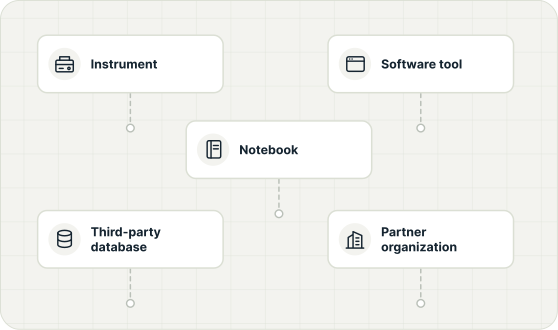
Instruments, software tools, notebooks, third-party databases, and partner organizations all start out disconnected.


Scientific Intelligence Platform
AI-powered data management and workflow automation for multimodal scientific discovery
Learn MoreCapabilities
Luma Products
Open Ecosystem & App Design
Luma connects to what's already in your stack and extends however your team builds, without asking you to lock in.

Ingest data from instruments, software, and database without replacing current systems.
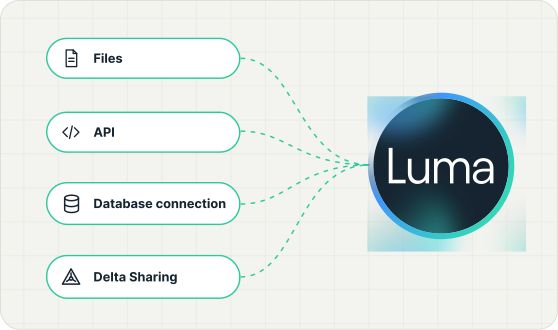
Choose files, REST APIs, direct database connections, or Delta Sharing.
Use customer partner tools and low-code internal apps.
Step 1
Instruments, software tools, notebooks, third-party databases, and partner organizations all start out disconnected.
Step 2
Luma meets your data where it already lives.
Step 3
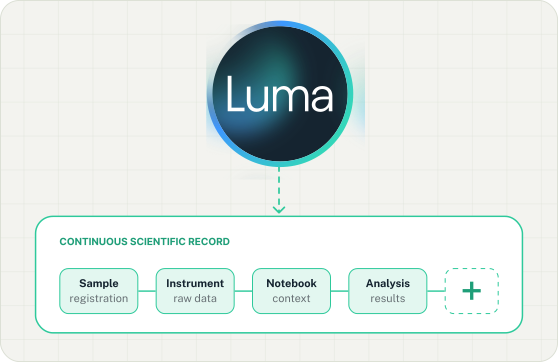
Everything becomes a single, continuous, contextualized scientific record.
Step 4
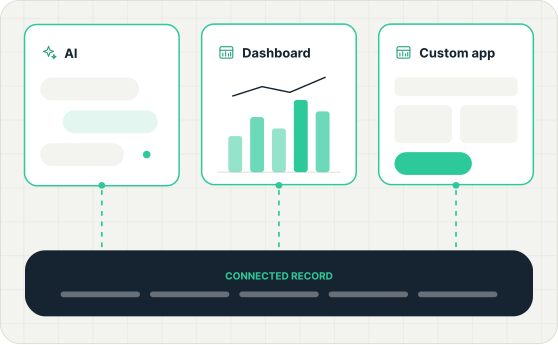
Apply AI, build custom tools, and make decisions from the same connected foundation.
Powered by the open ecosystem
Specialized tools can interface with Luma to work from the same connected record.

Plan retrosynthesis routes for chemistry, built on Luma's connected data.

Design proteins with a visual language built on the same scientific record.
Across the entire lab
Keep working in the tools you already know, while gaining access to specialized apps built on the same connected data.
Onboard new instruments and systems without a lab-wide rebuild.
Build custom integrations through open APIs, without fighting proprietary formats.
Protect existing technology investments instead of re-platforming every few years.
Avoid vendor lock-in that limits the lab's options down the road.
Luma's suite of capabilities builds on your connected data foundation through orchestration.
An electronic lab notebook where every entry stays linked to the samples, instrument data, and decisions around it.
Support every sample, compound, or material in a trusted data ecosystem.
The same harmonized data feeds specialized workflows across all layers of biology and chemistry.
Automate scientific insight and search with AI.
Turn connected data into dashboards and views built for scientific decision-making.
Connect instruments and third-party software in an open platform.
Capture instrument data automatically and keep its context wherever it goes.
No. Luma connects to what's already in your stack, files, APIs, databases, or direct sharing, without requiring you to replace it.
Luma ingests data through four routes: file-based sources that it watches and parses automatically, REST APIs, direct database connections, and Delta Sharing. You can mix them, so instruments, software tools, notebooks and partner organizations each connect in the way that fits.
Yes. Luma's open APIs and low-code app-building platform let your team build internal apps, dashboards and integrations on the same connected record, and specialized partner tools such as SYNTHIA and BioGlyph plug into it the same way.
No. Data stays accessible through open APIs, JDBC and Delta Sharing, so it can flow back out to the tools your team already uses. Luma is built to avoid vendor lock-in rather than create it.
No. Delta Sharing is one option for teams that already run Databricks, but files, REST APIs and direct database connections work without it.
No. Because Luma connects to what you already have, teams can start with a single instrument, workflow or data source and scale across the lab as their needs grow, without a lab-wide rebuild.
Next steps
Tell us about your research aims, instrument fleet, and data pain points, and we'll show you what Luma looks like for your lab.
See how Luma fits into the rest of the Dotmatics platform.